.png)
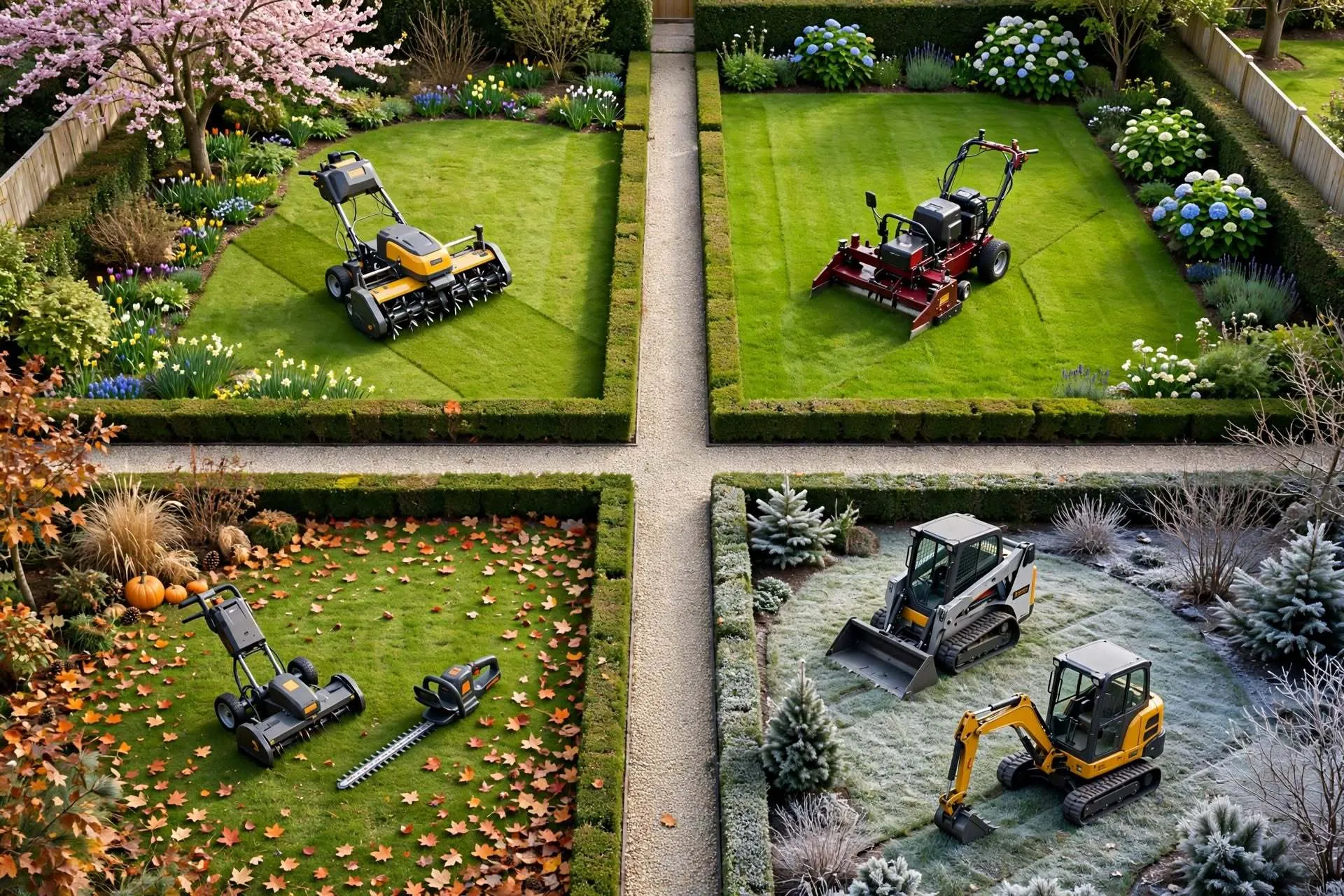
Ever stood in your backyard on a Saturday morning, coffee in hand, staring at a lawn that looks... fine, but not great? You're not imagining it. Lawns are living things, and like most living things, what they need changes with the calendar. The tool that saves your spring lawn is often useless by August, and the one that fixes your fall yard would've been overkill in June.
That's really what lawn equipment rental comes down to — picking the right tool for the season you're actually in, not the one you assumed you'd need. Let's walk through it, season by season, so you're never renting the wrong thing at the wrong time.
Why Your Lawn Equipment Needs Change With the Seasons
Here's a simple way to think about it: your lawn goes through a yearly cycle, and each stage of that cycle puts different stress on the soil and grass. In colder months, soil compacts. In warmer months, growth explodes. In transitional months, roots are either bracing for winter or waking up from it.
Because of that, no single machine covers the whole year. An aerator that's perfect for relieving compacted soil in spring won't do a thing for the overgrown hedges choking your fence line in July. A sod cutter that reshapes your yard's layout has a completely different job than an edger that just keeps your borders crisp. Trying to force one tool to do a job it wasn't built for is a bit like using a butter knife to cut a steak — technically possible, painfully inefficient.
Once you start thinking in seasons instead of "what do I need right now," lawn equipment rental stops feeling like guesswork and starts feeling like a plan.
There's also a timing element people underestimate. Grass and soil don't just react to what you do — they react to when you do it. Aerate too late in spring and you miss the window before the heat sets in and stresses the grass further. Trim hedges too late in fall and they'll carry that rough, half-finished shape through the entire winter. None of this is complicated once you know the pattern, but it does mean the "right" tool and the "right timing" are really the same decision, not two separate ones.
Spring Yard Projects and the Equipment That Gets Them Done
Spring is recovery season. Your lawn just survived winter, the soil is compacted from months of cold and foot traffic, and everything is trying to grow at once — including the weeds.
The single most impactful thing you can do in spring is aerate. Aeration pulls small plugs of soil out of the ground, which sounds minor but makes a huge difference — it lets air, water, and nutrients actually reach the roots instead of bouncing off compacted dirt. Think of it as opening the windows in a stuffy room. Nothing changes structurally, but suddenly everything breathes better.
If you're also reworking parts of your yard — maybe replacing a patchy section of grass or carving out space for a new flower bed — this is also prime time for a sod cutter. It slices cleanly under the existing turf so you can lift and relocate it without tearing up the roots or leaving a mess behind. Spring soil is typically soft enough to make this job manageable, which is exactly why so many yard redesigns start here.
Summer Yard Projects and the Equipment That Gets Them Done
By summer, the growing season is in full swing, and your equipment priorities shift from "recovery" to "control." Grass grows fast. Hedges grow faster. And borders that looked sharp in May start blurring into the lawn by July.
This is where an edger earns its keep. It's a small tool, but it does something disproportionately impactful — it creates that clean, defined line between your lawn and your driveway, walkway, or flower beds. Without it, even a freshly mowed lawn looks a little unfinished, like a haircut with no clean part.
Hedges and shrubs, meanwhile, don't just grow — they sprawl. A hedge trimmer keeps them in their lane, literally. Left unchecked through peak summer growth, hedges can quickly block windows, swallow walkways, or just look wild in a way that undercuts an otherwise tidy yard. Regular trimming through summer keeps shape and prevents the kind of overgrowth that turns into a much bigger job later.
Fall Yard Projects and the Equipment That Gets Them Done
Fall is where a lot of homeowners quietly drop the ball, mostly because it doesn't feel urgent. The grass isn't growing wildly anymore, so it's tempting to assume the yard work is done for the year. It isn't.
This is actually a second aeration window, and arguably an even more important one than spring. Aerating in fall gives grass roots a chance to strengthen before the ground freezes, which sets your lawn up to come back stronger — not just surviving winter, but genuinely recovering faster from it. Skip this step, and you're basically asking your lawn to go into winter already tired.
It's also a good time for one final edging and trimming pass. Hedges that finish the growing season a little wild will look that way — bare branches and all — for the entire winter if you don't shape them before growth stops. A clean fall trim is the difference between a yard that looks intentional in January and one that looks neglected.
Winter — What Actually Needs Doing (and What Can Wait)
Let's be honest about winter: most lawn equipment rental needs pause here, and that's fine. Grass isn't growing, hedges aren't sprawling, and the ground is often too hard or too wet for equipment like aerators or sod cutters to do their job properly anyway.
That doesn't mean winter is a total write-off. It's a good time to walk your yard and take stock — where did the edging get rough, which section of lawn struggled most, where do you want a new bed next spring. Winter is planning season, not equipment season. Use it that way, and spring stops being reactive.
Matching the Right Equipment to the Size of Your Project
Not every yard project stays inside "lawn care" in the traditional sense. Sometimes what starts as "I just want to fix this one patch of grass" turns into something bigger — regrading a slope, fixing drainage, or reshaping a section of yard entirely. That's a different category of tool.
When a Lawn Tool Isn't Enough: Bigger Yard Work
Here's a question worth asking honestly before you rent anything: is this a lawn care problem, or a land problem? An aerator or sod cutter handles the surface. But if you're moving real volumes of soil, correcting uneven grading, or dealing with drainage issues that go deeper than the top few inches of turf, you're in different territory.
Mini Skid Steer Rental for Grading and Leveling
If your project involves leveling out an uneven section of yard, clearing debris before a landscaping overhaul, or moving material around in tighter spaces where full-size equipment won't fit, a mini skid steer rental is usually the right scale of machine. It's compact enough to maneuver around fences, trees, and existing landscaping, but powerful enough to handle grading work that would take forever by hand.
Mini Excavator Rental for Digging and Drainage Work
If the project goes deeper — literally — like installing drainage lines, digging for a new garden bed foundation, or removing a stubborn tree root system, that's where a mini excavator rental fits. It's built for controlled digging in residential-sized spaces, which makes it a practical step up from hand tools without needing anything close to full construction-grade machinery.
The takeaway here isn't that every yard project needs heavy equipment — most don't. But knowing where the line is between "lawn care equipment" and "excavation equipment" saves you from either underpowering a big job or overcomplicating a small one.
A simple way to check yourself before renting: if you can picture doing the task with a hand tool, even if it would take a while, you're probably still in lawn equipment territory. If the honest answer is "there's no realistic way to do this without a machine," that's your cue to step up to a mini skid steer or mini excavator instead. It's not about picking the biggest available option — it's about picking the smallest one that actually gets the job done, since that's usually the easiest to maneuver and the most practical for a residential-sized yard anyway.
Conclusion
Lawn care isn't a one-tool job, and it was never supposed to be. Spring calls for aeration and sod work. Summer is about keeping growth under control with edging and trimming. Fall is your second, often-overlooked chance to set the lawn up for winter. And when a project outgrows what lawn equipment can handle, that's your signal to look at something like a mini skid steer or mini excavator instead.
The real skill in lawn equipment rental isn't knowing every tool that exists — it's knowing which one matches what your yard actually needs, right now, this season. Get that timing right, and the rest tends to fall into place.
Think of your yard less like a one-time project and more like an ongoing conversation — it tells you what it needs through compacted soil, overgrown edges, or a sluggish recovery after winter. Your job is just to listen and bring the right tool to the conversation each time.
Frequently Asked Questions
1. How often should I aerate my lawn? Most lawns benefit from aeration twice a year — once in spring to relieve winter compaction, and once in fall to strengthen roots before the ground freezes.
2. What's the difference between an edger and a hedge trimmer? An edger creates clean borders between your lawn and hardscape surfaces like driveways or walkways. A hedge trimmer shapes and controls the growth of shrubs and hedges. They handle completely different parts of yard maintenance.
3. When is the best time to use a sod cutter? Sod cutters work best in spring or early fall, when soil is soft enough to cut cleanly but stable enough that the removed sod can be relocated without falling apart.
4. Do I need lawn equipment in winter? Generally, no. Most lawn equipment work — aeration, edging, trimming — pauses in winter since grass isn't actively growing and soil conditions often aren't suitable.
5. How do I know if my project needs a mini skid steer or mini excavator instead of lawn equipment? If the work involves moving or leveling large amounts of soil, it's a mini skid steer job. If it involves digging deeper for drainage, roots, or foundations, a mini excavator is the better fit. Surface-level lawn work stays within standard lawn care equipment.