.png)
Ever had that moment where you've done all the regular lawn work - mowed, edged, even aerated - and the yard still looks off? The grass is fine, the borders are clean, but something about the ground itself doesn't feel right. Water pools in one corner, one side of the yard sits higher than the other, or that new flower bed idea just won't work because the ground underneath is a mess.
That’s usually the point where the question changes. It’s no longer about taking care of the lawn. It’s about fixing what’s under it.
Where Regular Lawn Equipment Stops
Tools like an aerator, sod cutter, or edger are built for the top few inches. They breathe life into the soil, give you clean lines, and help you reshape turf.
But they don't move large amounts of earth. If your project involves leveling an uneven patch, clearing out a lot of debris before a redesign, or fixing a slope where water always collects, you’re past surface work. You need to move or dig soil, not just care for it.
A simple check that helps: if you can picture doing it with a shovel and wheelbarrow, even if it would take a full weekend, you’re still in lawn equipment territory. If your honest answer is "there's no realistic way to do this by hand," it’s time to look at a different category of machine.
When a Mini Skid Steer Rental Makes Sense
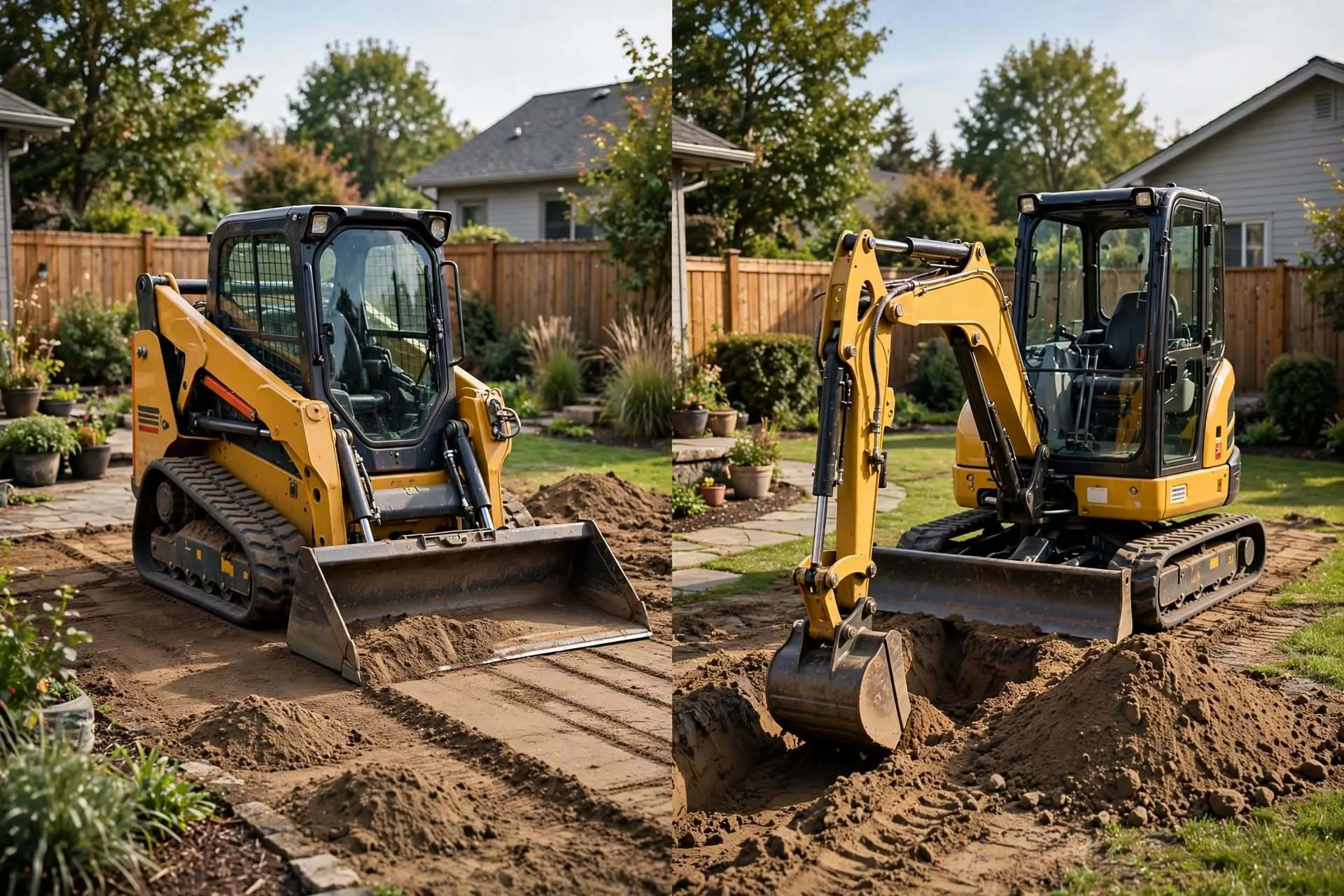
If your yard needs leveling in tight space, a mini skid steer rental is built for moving and grading in residential yards. It’s small enough to get through a standard gate, turn around a tree, and work close to a fence without tearing up everything around it, but it has the power to push, lift, and grade soil that would take hours manually.
This is the one people usually need when:
- A section of the yard is uneven and needs to be leveled before seeding again
- You’re clearing old mulch, small stumps, or construction debris before a landscaping reset
- You need to move soil, gravel, or mulch from the driveway to the back corner of the yard
- You’re regrading a gentle slope so water flows away from the house
It’s less about digging deep and more about getting the surface level and clean, quickly, in a space where a full-size machine just won't fit.
When a Mini Excavator Rental Is the Better Fit
A mini excavator rental is made for controlled digging. Where a skid steer pushes and levels, an excavator reaches down for drainage and base work.
You end up needing it when the work goes deeper than the turf:
- Digging a trench for a drainage line that keeps clogging
- Cutting out a proper base for a new garden bed or patio edge
- Removing a stubborn root system that keeps coming back
- Creating depth for a small retaining wall footing
Both machines can work in a home yard, but they solve different problems. One handles what needs to be moved across the yard, the other handles what needs to come out of it.
| Type of Work | Mini Skid Steer | Mini Excavator |
| Leveling uneven ground | Yes, this is its main job | No, not built for grading |
| Moving soil, mulch, gravel | Yes | No, limited carrying ability |
| Digging for drainage or deep base | No | Yes, precise deep digging |
| Working in narrow side yards | Yes, compact turn radius | Yes, works from one spot |
| Clearing surface debris | Yes | No |
If you’re moving material from point A to point B and making the ground even, that’s skid steer work. If you’re opening up the ground to fix something underneath, that’s excavator work. Sometimes a bigger backyard project needs both in sequence — dig first, then level.
Three Questions to Ask Yourself Before You Rent
This is where most people save time. Walk your yard and ask:
1. Can this be done realistically by hand? If yes, even if it’s slow, you might still be okay with lawn equipment. If no, a machine will actually save your yard from extra damage.
2. How deep do I need to go? A few inches to level? Skid steer. A foot or more to lay pipe or remove roots? Excavator.
3. How much space do I have to maneuver? Measure your narrowest gate and check for low branches. Both machines are built for residential access, but knowing your space helps you plan where material will go.
Answering these three in order usually makes the choice clear without any guesswork.
The Mistake That Turns a Small Job Into a Big One
A common thing we see is picking a machine that’s too big for the job, or starting at the wrong time of year. Spring and early fall soil is usually more workable for both grading and digging. In peak summer heat, the ground can be bone hard, and in deep winter, it can be too wet or frozen for clean work.
Another one is treating edging and grading as the same thing. A crisp edge makes a lawn look finished, but it won’t fix water pooling. Grading fixes water flow, edging fixes appearance. They are two different steps, and doing them in the right order makes the yard look intentional.
Frequently Asked Questions
What’s the difference between lawn equipment and these machines?
Lawn equipment works on the grass and top layer of soil. A mini skid steer and mini excavator work on the earth itself — moving, leveling, and digging it.
Can a mini skid steer damage my existing lawn?
Any heavy machine will leave tracks if the ground is very soft. Planning your path and working when soil is firm but not frozen helps keep the surrounding lawn in better shape.
How deep can a mini excavator dig in a home yard?
It’s designed for controlled residential digging — enough for drainage lines, garden foundations, and root removal. Exact depth depends on the model and soil condition.
Do I need both machines for one yard project?
Sometimes. For example, you might dig a drainage trench with an excavator, then use a skid steer to bring in new soil and level the area back out.
When is the right time to rent for grading or digging?
Many homeowners plan this work for spring or early fall, when soil conditions make grading and digging more manageable and the yard can recover before the next extreme season.
Conclusion
Your yard tells you what it needs if you walk it slowly. If the grass looks tired, it’s probably asking for air and care. If the ground itself is uneven, holds water, or won’t let you build what you planned, it’s asking for grading or digging.
Lawn care equipment keeps the surface healthy. A mini skid steer helps you reshape and level that surface. A mini excavator helps you fix what’s underneath it.
Think less about which machine is bigger and more about which job your yard is actually asking for right now. Get that part right, and the rest of the project gets a lot simpler.